

Last week a customer asked if we had a visual of the DOD household goods invoicing process to help him understand (and explain to his bank) why transmission issues happen. I shared the diagram below, which we use internally, and thought it might be a useful reference for others trying to understand why these problems occur.
The diagram traces an invoice from the moment Daycos submits it on behalf of our customer to the moment that customer is paid. There are ten steps in all, and this is the best-case scenario, with no denials, disputes, or amounts large enough to require secondary approvals.
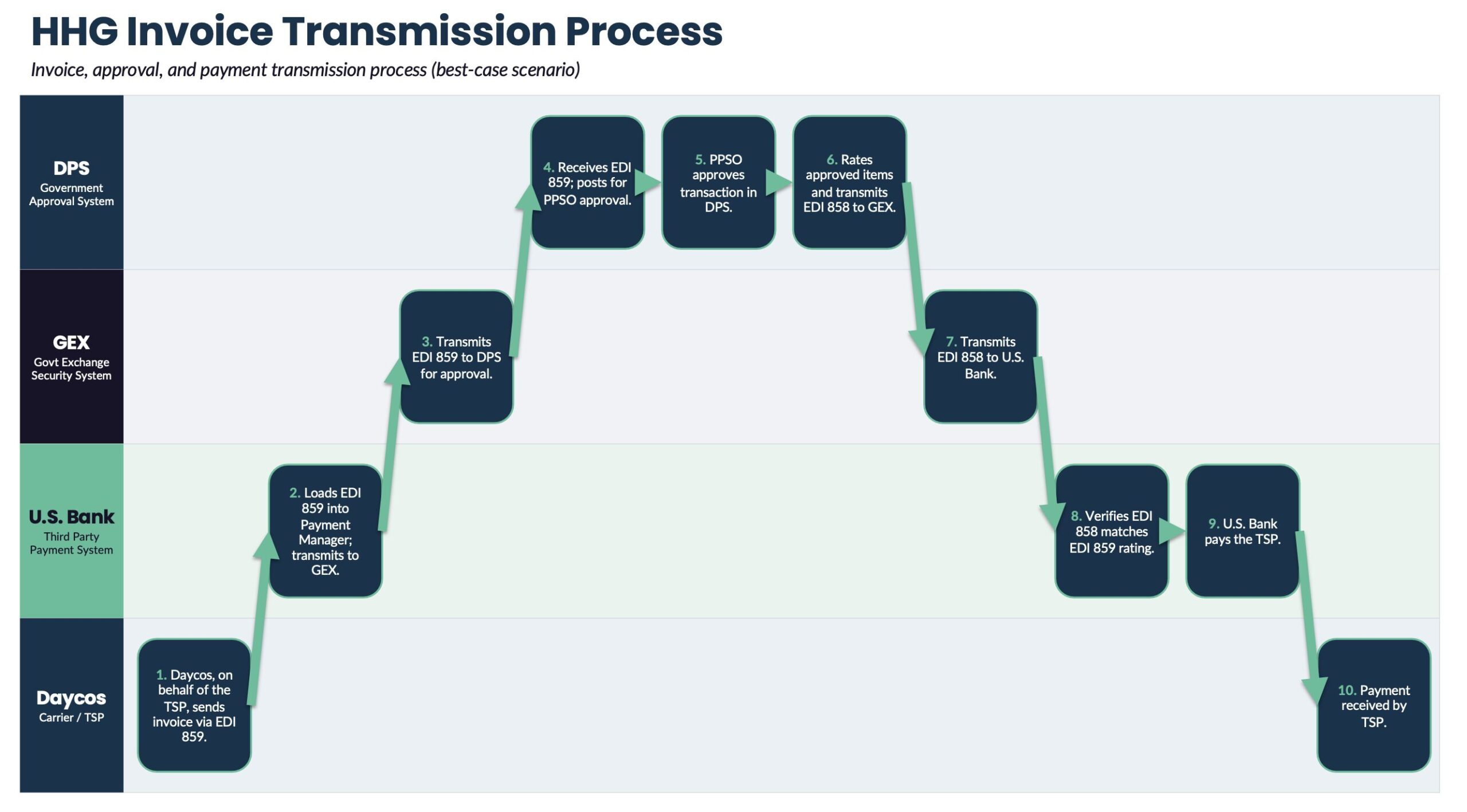
Every one of those steps creates a chance that the invoicing process will break down, creating a transmission issue. Over the years, Daycos has created a detailed tracking system to help ensure our customers’ invoices move through the process without delay. If an invoice batch does not appear in a system when expected, we begin troubleshooting right away, alerting the other entities involved and opening help desk tickets as needed. Most of the time these issues are short-lived, and invoices resume flowing without much impact.
The issue that began on June 18th was different, mainly because the issue involved GEX. GEX is the security layer that sits between the U.S. Bank Third-Party Payment System and DPS. For security reasons, U.S. Bank cannot send files directly to DPS, so everything routes through GEX in both directions.
When GEX is the cause of a problem, resolution tends to be slower than with the other partners. We speculate this is for a couple of reasons. First, before GEX can be identified as the source of the issue, it seems like both U.S. Bank and DPS have to confirm their own systems are sending and receiving correctly. Second, because GEX is not specific to household goods processing, getting the right resources engaged can take longer than it typically does with U.S. Bank or DPS. Adding to the challenge is the fact that we have no visibility into the GEX system, so we are unable to help the bank or the government pinpoint the source of the issue.
In the most recent transmission issue, once GEX was able to resolve the issue, newly submitted invoices began flowing from U.S. Bank to DPS, and newly approved invoices began flowing back for payment. However, both U.S. Bank and DPS had to requeue a number of batches to clear the invoices that had been stalled during the transmission problem.
There is also a secondary effect that will continue to impact cash flow. Since invoices were not reaching the PPSOs for approval, they could not work their normal schedule. Now that the backlog has been released, a large volume of invoices is sitting in their DPS invoice approval queues, amplified by peak season and a holiday weekend landing in the middle of it. As a result, industry will likely see some delay before cash flow timing returns to normal.
Daycos will continue to monitor progress on the backlog, as well as any new invoices submitted, to help ensure that our customers’ cash flow continues to move as smoothly as possible. We are at a time of year where any disruption to cash flow can have a paralyzing effect on the industry, due to the volume of shipments in process. We will remain diligent in monitoring and working any issues that have the potential to further threaten our customers’ payments.